 Posted by
 What is Microsoft Foundry?
Microsoft Foundry is Azure’s answer to a long-standing enterprise challenge: AI development has been fragmented, requiring teams to juggle separate services, endpoints, SDK packages, and billing models just to get a single application into production.
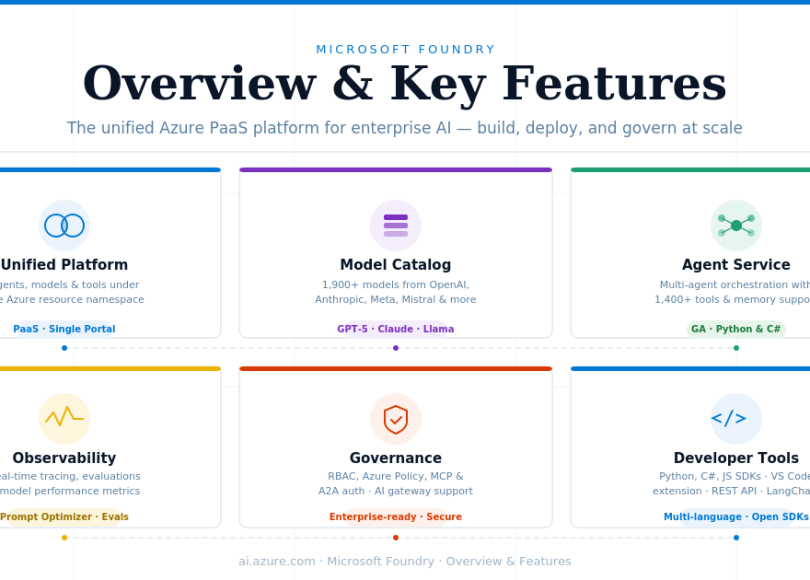
Foundry consolidates all of this into a single, unified platform-as-a-service offering. Agents, models, tools, observability, and governance all live under one Azure resource provider namespace — managed through a single portal, one RBAC policy, and a consistent API surface.
| KEY SHIFT Previous Azure AI workflows required navigating separate hubs, multiple SDK packages, and 5+ distinct endpoints. Foundry replaces all of this with a single project client and one unified project endpoint. |
Core Capabilities
The platform is designed around three primary concerns: building, operating, and governing AI at enterprise scale.
| Multi-Agent Orchestration Build collaborative agent workflows with complex execution logic using Python and C# SDKs. | Tool Catalog Connect over 1,400 tools through public and private catalogs for rich agent capabilities. |
| Memory & Knowledge Retain context across sessions and ground responses in enterprise content with Foundry IQ. | Real-Time Observability Monitor performance, governance, and model behavior with built-in tracing and evaluations. |
Beyond these core pillars, Foundry also offers:
- Publishing agents directly to Microsoft 365, Teams, BizChat, or containerized deployments
- Centralized AI asset management across all agents, models, and tools from the Operate section
- Full authentication support for MCP and A2A, AI gateway integration, and Azure Policy
- LangChain and LangGraph integration for open-source framework compatibility
A Massive Model Catalog
One of Foundry’s headline features is access to over 1,900 models from the world’s leading AI providers — all accessible through a single, consistent API.
| GPT-5 | GPT-4.1 | Claude | Grok |
| Mistral | DeepSeek-R1 | Phi-4 | Meta Llama |
Whether you need GPT-5 for complex multi-step reasoning, Claude for advanced code generation, or Phi-4 for resource-constrained edge deployments, Foundry gives you a unified interface to discover, evaluate, and deploy the right model for your workload.
Pricing & Getting Started
The platform itself is free to explore. Costs are incurred at the deployment level — each model, agent, or tool carries its own billing model. Pricing is transparent and manageable through the Azure cost management tooling.
Discover more from Praveen Kumar Sreeram's Blog
Subscribe to get the latest posts sent to your email.
