 Posted by
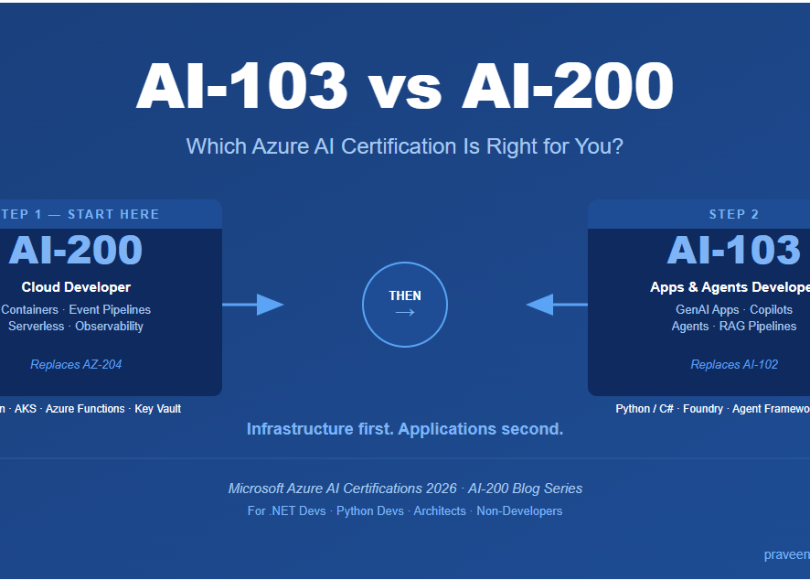
 Every few weeks a student sends me a version of the same message: “I’m a .NET developer — which cert should I take?” Or: “I’m not a developer at all — is AI-200 for me?” The question makes sense. Microsoft just retired AI-102 and AZ-204, and replaced them with two brand-new certifications — AI-103 and AI-200 — whose names sound almost identical to people who haven’t dug into the details.
This article gives you a straight answer. We’ll look at what each certification actually tests, who each one is designed for, and what your path looks like depending on your role — whether you’re a Python developer, a .NET developer, or someone who doesn’t write code at all.
The Big Picture: Why These Two Certs Exist
Microsoft retired AI-102 (Azure AI Engineer Associate) on June 30, 2026, and AZ-204 (Azure Developer Associate) on July 31, 2026. Their replacements are not simply renamed versions of the old exams — they are genuinely different credentials built for the AI era.
| AI-103 | AI-200 | |
| Replaces | AI-102 (Azure AI Engineer Associate) | AZ-204 (Azure Developer Associate) |
| Certification name | Azure AI Apps and Agents Developer Associate | Azure AI Cloud Developer Associate |
| Core focus | Building AI apps, agents & RAG pipelines on Azure AI Foundry | Building cloud-native, event-driven AI back-end services on Azure |
| Primary platform | Azure AI Foundry, Azure OpenAI, Copilot Studio, Microsoft Agent Framework | Azure Container Apps, AKS, Azure Functions, Azure AI Search, Event Grid |
| Audience | Developers building GenAI apps, copilots, and autonomous agents | Back-end / cloud developers building the infrastructure AI runs on |
| Coding languages | Python (primary), C# | Python (primary) — .NET/C# not explicitly in scope |
| Exam beta launched | April 2026 | May 2026 |
| Expected GA | June 2026 | July 2026 |
| One-line summary: AI-103 is about what AI does (apps and agents). AI-200 is about where AI runs (the cloud infrastructure behind it). |
AI-200 — Azure AI Cloud Developer Associate
Start here. Before you build an AI agent, you need to understand where it will run, how it will scale, and how it will stay observable in production. AI-200 gives you that foundation. It’s the infrastructure layer — and infrastructure shapes every architecture decision that comes after it.
What It Tests
AI-200 validates your ability to build the back-end cloud infrastructure that AI solutions run on. It replaces AZ-204 and keeps its cloud development foundations — containers, serverless, messaging, monitoring — but repositions all of them around AI solution implementation.
| Skill Domain | Exam Weight |
| Develop AI solutions using Azure data management services | 25–30% |
| Develop containerized solutions on Azure | 20–25% |
| Implement event-driven AI pipelines | 20–25% |
| Build serverless inference endpoints | 15–20% |
| Monitor and secure AI solutions | 10–15% |
Notice what’s NOT on this list: prompt engineering, agent reasoning loops, LLM orchestration. AI-200 assumes those concerns belong to AI-103. Your job is to build the container the model runs in, the event-driven pipeline that feeds it data, the vector database it queries, and the observability stack that monitors it all.
Key Technologies You Must Know
- Azure Container Apps and AKS — deploying containerized AI workloads at scale
- Azure Functions — serverless compute for inference endpoints and AI triggers
- Azure Event Grid and Service Bus — event-driven AI pipeline orchestration
- Vector databases — embedding storage and semantic retrieval patterns
- Azure AI Search — indexing pipelines, vector search implementation
- Azure Key Vault and Managed Identity — secret management for AI workloads
- Distributed observability — tracing, logging, health monitoring across AI pipelines
- Azure Machine Learning — model deployment and lifecycle management
Who AI-200 Is For
AI-200 is for developers whose work lives in infrastructure and back-end services. You’re not the person writing the prompt — you’re the person building the system the prompt runs through. If you came from AZ-204 and built web apps, APIs, and Azure Functions, AI-200 is your natural upgrade path.
| Take AI-200 if you are: A back-end developer building cloud-native services | Coming from an AZ-204 background | A developer responsible for deploying and scaling AI workloads | Someone who designs event-driven pipelines and container architectures for AI systems. |
A Note on .NET and AI-200
The official AI-200 study guide explicitly lists Python programming as a prerequisite knowledge area. .NET and C# are not mentioned. This doesn’t mean .NET developers cannot do the work AI-200 tests — containerisation and event-driven design are language-agnostic concepts. But if you’re a .NET developer, expect to be tested through a Python-and-Azure-CLI lens. Factor in study time to get comfortable with Python-based Azure SDK examples and YAML-heavy container configurations.
AI-103 — Azure AI Apps and Agents Developer Associate
Once you understand the infrastructure (AI-200), AI-103 is where you build what runs on it. This is the application layer — generative AI apps, copilots, autonomous agents, RAG pipelines. Knowing how your agents deploy makes you a better AI-103 developer, which is exactly why AI-200 comes first.
What It Tests
AI-103 validates your ability to design, build, and deploy AI applications and autonomous agents on Azure, using Azure AI Foundry as the central platform. The exam is heavily weighted toward generative AI and agentic workflows.
| Skill Domain | Exam Weight |
| Implement generative AI and agentic solutions | 30–35% |
| Plan and manage an Azure AI solution | 25–30% |
| Implement computer vision solutions | 10–15% |
| Implement natural language processing solutions | 10–15% |
| Implement information extraction and RAG pipelines | 10–15% |
The largest domain — generative AI and agentic solutions — is where this exam separates itself from its predecessor AI-102. It’s not just about consuming Azure AI services. It’s about building agents that can reason, use tools, call functions, and operate autonomously across multi-step workflows.
Key Technologies You Must Know
- Azure AI Foundry — the unified platform for building, deploying, and managing AI models and agents
- Azure OpenAI Service — GPT-4 deployments, prompt engineering, function calling
- Microsoft Agent Framework — Microsoft’s framework for building, orchestrating, and running AI agents
- Copilot Studio — building declarative copilots for business users
- RAG (Retrieval-Augmented Generation) — connecting LLMs to your own data via Azure AI Search
- Azure AI Search — vector search, semantic ranker, indexing pipelines
- Responsible AI controls — content filters, groundedness evaluation, safety guardrails
- Multi-agent orchestration — agent-to-agent communication, tool calling, memory patterns
Who AI-103 Is For
AI-103 is the right path if your primary job — or target job — is building AI-powered applications. You don’t need to manage the infrastructure they run on. You’re the developer who writes the code that talks to the LLM, designs the agent’s reasoning loop, builds the RAG pipeline, or deploys the copilot.
| Take AI-103 if you are: A developer building GenAI apps, chatbots, or copilots | An AI engineer implementing RAG and vector search | Coming from an AI-102 background and want to stay current | A developer on any stack who works primarily with AI services and models. |
What About .NET / C# Developers?
The official AI-103 study guide lists Python as the primary language, but C# is also supported. Microsoft Agent Framework — one of the core technologies on the exam — has full C# SDKs. If you’re a .NET developer who wants to build AI agents and copilots, AI-103 is absolutely still accessible to you. The exam tests concepts and Azure service knowledge, not language syntax. You will, however, need to be comfortable reading Python code in lab scenarios and practice exams.
Your Path by Role
I’m a Python Developer
You’re in the best position — both certifications assume Python as the primary language. The recommended order is AI-200 first, then AI-103.
- AI-200 first: understand the infrastructure your AI apps will run on — containers, event pipelines, serverless, observability.
- AI-103 second: build the AI apps and agents that run on that infrastructure.
- Doing it in this order means your AI-103 work is grounded in real deployment context, not just abstract service calls.
I’m a .NET / C# Developer
Both paths are open to you, but with different preparation overhead. The recommended order is still AI-200 first, then AI-103.
- AI-200 first: infrastructure and container concepts are language-agnostic. You’ll need to get comfortable with Python-based SDK examples, but the underlying Azure concepts translate directly from .NET experience.
- AI-103 second: Microsoft Agent Framework has full C# support, making this the more natural .NET developer territory. Once you have the infra context from AI-200, AI-103 is a strong fit.
- Don’t skip AI-200 because it ‘feels like Python territory’. Knowing how your agents deploy makes every AI-103 design decision sharper.
I’m a Solution Architect or Tech Lead
The community — and several conference talks — informally point architects toward what some call “AI-500 level” thinking: the ability to design end-to-end multi-agent AI systems across the full Azure stack. Officially, Microsoft’s closest equivalent today is AB-100 (Microsoft Certified: Agentic AI Business Solutions Architect), an expert-level credential for architects designing multi-agent AI systems integrating Copilot, Azure AI Foundry, and Dynamics 365.
That said, no architect should attempt expert-level design without both associate-level foundations. The recommended path:
- AI-200 first: understand the cloud infrastructure layer — this anchors every architectural decision about deployment, scale, and resilience.
- AI-103 second: understand the AI application layer — agents, RAG, Foundry workflows, responsible AI controls.
- AB-100 / expert path: once both associates are solid, this is where end-to-end AI solution architecture is formally validated.
| Note: “AI-500” is not an official Microsoft certification number as of June 2026. It’s community shorthand for the expert-level architect credential space — currently represented by AB-100. Always verify against Microsoft Learn before planning your exam schedule. |
I’m Not a Developer — Is Either Cert For Me?
If you don’t write production code, neither AI-103 nor AI-200 is the right starting point. Both are developer-role certifications that require hands-on coding proficiency. There are better options:
| Certification | Who It’s For | Coding Required? |
| AI-901 (Azure AI Fundamentals) | Anyone starting their AI journey — analysts, IT managers, students | No |
| PL-900 (Power Platform Fundamentals) | Business professionals using low-code/no-code tools | No |
| Copilot Studio (Power Platform path) | Business users building copilots without code | Minimal |
| AI-200 | Developers building AI cloud infrastructure | Yes — Python |
| AI-103 | Developers building AI apps and agents | Yes — Python / C# |
| Non-developers: Start with AI-901. It covers AI concepts, Azure AI services, responsible AI, and Copilot features without requiring any coding. It’s the right foundation before deciding whether to go deeper on the technical path. |
Side-by-Side: AI-103 vs AI-200
| Question | AI-103 | AI-200 |
| What problem does it solve? | How do I build smart AI apps and agents? | How do I build scalable cloud infrastructure for AI? |
| Where does my code run? | Azure AI Foundry, Azure OpenAI, Copilot Studio | Containers, Azure Functions, event-driven pipelines |
| What’s the hardest topic? | Multi-agent orchestration and RAG quality evaluation | Event-driven AI pipelines and distributed observability |
| Who do I collaborate with? | Data scientists, solution architects, DevOps teams | AI developers (AI-103 holders), security engineers, platform teams |
| Recommended order | Take second — build on the infra foundation | Take first — it’s the foundation everything else runs on |
| Does it expire? | Yes — annual renewal via free online assessment | Yes — annual renewal via free online assessment |
| Coming from… | AI-102 holders, GenAI developers | AZ-204 holders, back-end developers |
Key Exam Takeaways
| Takeaway | AI-103 | AI-200 |
| Top domain by weight | Generative AI and Agentic Solutions (30–35%) | AI Data Management Services (25–30%) |
| Most important framework/SDK | Microsoft Agent Framework, Azure AI Foundry SDK | Azure SDK for Python, Azure Container SDK |
| Infrastructure knowledge needed? | Moderate — helps to know where your agents run | Heavy — containers, events, serverless, observability |
| Agent/GenAI knowledge needed? | Heavy — RAG, prompt engineering, agent design | Moderate — you need to know what you’re deploying |
| Predecessor retired | AI-102 — retired June 30, 2026 | AZ-204 — retiring July 31, 2026 |
| Expected GA | June 2026 | July 2026 |
| Recommended sequence | Step 2 | Step 1 |
Practical Scenario: The Same Company, Two Different Certs
Imagine Contoso is building a customer support system powered by AI. There are two developers on the project:
Arjun (AI-200) builds the infrastructure first. He deploys the AI pipeline as a containerized service on Azure Container Apps, sets up the Event Grid pipeline that triggers re-indexing when product data changes, wires up Azure Key Vault for secret management, and configures distributed tracing so the team can debug slow responses in production. Without Arjun’s layer, nothing runs.
Priya (AI-103) builds the customer-facing copilot on top of Arjun’s infrastructure. She designs the agent’s conversation flow using Microsoft Agent Framework, connects it to Contoso’s product database via a RAG pipeline on Azure AI Search, adds content safety filters in Azure AI Foundry, and evaluates groundedness of the AI’s responses before go-live.
Arjun’s work is the prerequisite. Priya’s work is what the business sees. Both certifications are validated on this project — and the order matters: infrastructure first, application second.
| The pattern holds at scale: AI-200 is the foundation. AI-103 is what you build on it. The team needs both, and the learning order should reflect the dependency. |
Conclusion
The question “AI-103 or AI-200?” has a clearer answer once you understand that they’re not alternatives — they’re layers. Infrastructure comes before application. That’s why AI-200 is the recommended starting point for all developers, regardless of background.
- You build AI cloud infrastructure, pipelines, and containers → AI-200 first
- You build AI applications, agents, and GenAI features → AI-200 first, then AI-103
- You’re a .NET developer → AI-200 (with Python prep), then AI-103 via Microsoft Agent Framework in C#
- You’re a solution architect → AI-200 + AI-103, then AB-100 for the expert-level path
- You don’t write code → start with AI-901, then decide
Neither certification is better than the other. They are designed for different layers of the same system. Start with the foundation. Build up from there.
Do you like this article? If you want to get more updates about these kind of articles, you can join my Learning Groups
Discover more from Praveen Kumar Sreeram's Blog
Subscribe to get the latest posts sent to your email.
