 Posted by
 The Big Change: What’s Happening?
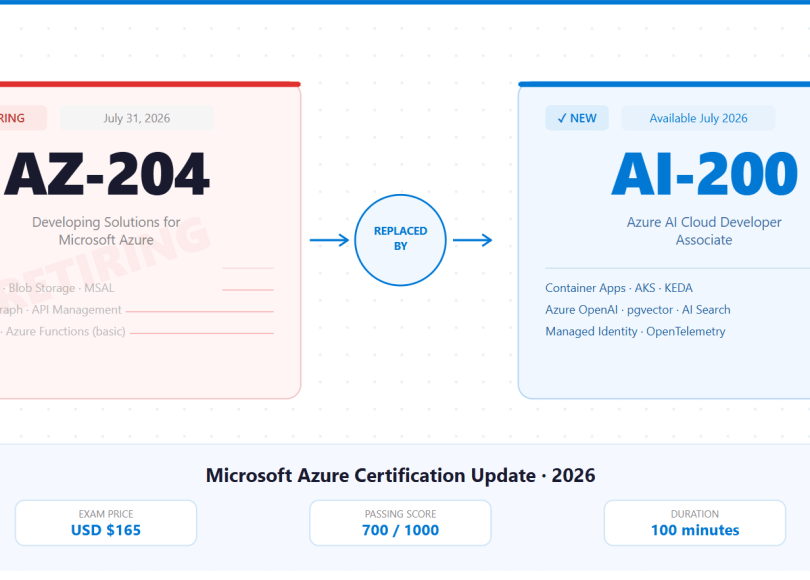
Microsoft has officially announced that AZ-204: Developing Solutions for Microsoft Azure — one of the most popular Azure developer certifications — will retire on July 31, 2026. In its place, Microsoft is introducing AI-200: Developing AI Cloud Solutions on Azure, which leads to the new Microsoft Certified: Azure AI Cloud Developer Associate credential.
This is not a cosmetic update. It represents a fundamental rethinking of what it means to be an Azure developer in the age of AI. If you are currently preparing for AZ-204 or planning to pursue the Azure Developer Associate path, this change directly affects you.
Key Dates at a Glance
| Event | Date |
| AI-200 Beta Exam Launch | April 2, 2026 |
| AI-200T00 Training Course Published | April 30, 2026 |
| AI-200 General Availability | July 2026 |
| AZ-204 Retirement Deadline | July 31, 2026 |
Why Is Microsoft Making This Change?
The shift from AZ-204 to AI-200 reflects a broader industry transformation. AI-powered application development is no longer a niche specialisation — it has become the standard expectation for cloud developers in enterprise environments.
Microsoft’s 2026 certification overhaul is one of the biggest restructurings in the last decade. Across the board, older certifications are being retired and replaced with AI-aligned alternatives:
- AZ-204 (Azure Developer Associate) → AI-200 (Azure AI Cloud Developer Associate)
- AZ-500 (Azure Security Engineer) → SC-500 (Cloud and AI Security Engineer)
- DP-100 (Data Scientist Associate) → AI-300 (Machine Learning Operations Engineer)
- AI-900 (Azure AI Fundamentals) → AI-901 (updated fundamentals, launched March 2026)
The message from Microsoft is clear: every developer role on Azure is now expected to understand how to build, deploy, and operate AI solutions in production.
AZ-204 vs. AI-200: What Actually Changed?
While approximately 60% of AZ-204’s content carries over into AI-200, the shift in focus is significant. Here is how the two exams compare:
| Area | AZ-204 (Retiring) | AI-200 (Replacement) |
| Compute | App Service, Azure Functions (basic) | Container Apps, AKS, KEDA-based event-driven scaling |
| Data | Blob Storage, Cosmos DB, SQL | Cosmos DB (vector search), PostgreSQL + pgvector, Azure Managed Redis |
| Messaging | Event Hubs, Service Bus (general) | Service Bus, Event Grid (AI pipeline focus) |
| AI Integration | Limited — Azure Cognitive Services basics | Azure OpenAI, AI Foundry, Document Intelligence, AI Search |
| Security | MSAL, Microsoft Graph, API Management | Managed Identity, Entra ID, Key Vault (primary pattern) |
| Observability | Application Insights (basic) | OpenTelemetry, KQL, distributed tracing for AI workloads |
Topics Dropped From AZ-204
If you were studying for AZ-204, several topics that appeared there will not be tested in AI-200. These include:
- Blob Storage SDK deep dives
- MSAL and Microsoft Graph integration
- API Management configuration
- Azure Event Hubs (now de-emphasised)
There is no value in studying these topics if you are pivoting directly to AI-200.
What AI-200 Emphasises
The AI-200 exam is built around four core skill domains:
- Containerised Compute — Azure Container Registry, Container Apps, AKS, and KEDA-based autoscaling for AI workloads
- AI-Enabled Data Services — Vector search in Cosmos DB for NoSQL, PostgreSQL with pgvector, and Azure Managed Redis as a caching and semantic layer
- Event-Driven AI Pipelines — Service Bus, Event Grid, and serverless Functions for orchestrating asynchronous AI processing workflows
- AI Service Integration, Identity & Observability — Azure OpenAI, AI Search, Entra ID with Managed Identity, Key Vault, Application Insights, and OpenTelemetry
AI-200 Exam Details
Here is what candidates need to know about the AI-200 exam format:
| Detail | Information |
| Full Exam Name | Developing AI Cloud Solutions on Azure |
| Certification | Microsoft Certified: Azure AI Cloud Developer Associate |
| Certification Level | Associate |
| Exam Code | AI-200 |
| Exam Price | USD $165 (standard) |
| Number of Questions | ~40–60 questions |
| Duration | 100 minutes |
| Passing Score | 700 out of 1000 |
| Question Types | Single-choice, multiple-response, hotspot, drag-and-drop |
| Beta Launched | April 2, 2026 |
| General Availability | July 2026 |
Should You Take AZ-204 or Switch to AI-200?
This is the most common question professionals are asking right now. The answer depends on where you are in your preparation:
Take AZ-204 if:
- You are already deep into your study preparation and can realistically sit the exam before July 31, 2026
- Your current development work spans the full Azure developer stack — App Service, Functions, storage, Cosmos DB
- You want to lock in the credential; it remains valid through its full renewal cycle even after the exam retires
Switch to AI-200 if:
- You are early in your preparation or starting from scratch
- Your work is moving toward AI-powered applications, containerised workloads, or Azure OpenAI integrations
- You want a certification that reflects where Azure development is heading, not where it has been
- You do not want to invest time in topics (MSAL, Blob SDK, API Management) that will not appear on any future exam
As one study guide author put it: if you sit AZ-204 now and need to renew later, you will renew into AI-200 anyway. Save the round trip and start on AI-200 directly.
How AI-200 Fits Into the Broader AI Certification Landscape
It is worth understanding how AI-200 sits alongside the other AI-focused certifications Microsoft now offers:
- AI-102 / AI-103 (Azure AI Engineer) — Focuses on AI model selection, agents, RAG design, prompt flows, and conversational AI. This is for the person designing the AI solution.
- AI-200 (Azure AI Cloud Developer) — Focuses on the back end that runs AI in production: containers, Cosmos DB with vectors, pgvector, Service Bus, Key Vault, and KQL. This is for the person wiring AI into a real Azure environment.
- AI-300 (MLOps Engineer Associate, replacing DP-100) — Focuses on machine learning pipelines and model operations.
AI-200 and AI-103 do not overlap heavily and can be held together on a CV — they are complementary, not competing credentials.
Recommended Preparation Resources
For candidates planning to pursue AI-200, here are the recommended starting points:
- Microsoft Learn — The official AI-200 study guide is available at learn.microsoft.com, covering all exam objectives with learning paths and hands-on sandboxes
- AI-200T00-A Official Course — Microsoft’s official instructor-led training course, published April 30, 2026, covering all four exam domains
- Azure Free Account — Essential for hands-on practice with Container Apps, AKS, Cosmos DB vector search, and Azure OpenAI
- Microsoft Community Hub — Official Microsoft blog posts about AI-200 launch details and exam preparation guidance
Key preparation tips from early exam candidates include: prioritising Managed Identity and Entra ID patterns (connection strings are almost always wrong answers), mastering vector search across Cosmos DB, pgvector, and Azure Managed Redis, and getting hands-on with the full data path before picking a service in scenario questions.
The Bottom Line
The retirement of AZ-204 and the introduction of AI-200 is a clear signal from Microsoft about where the industry is heading. Azure development is no longer just about deploying web apps and managing storage — it is about building production AI systems that are containerised, event-driven, semantically searchable, and fully observable.
For Azure developers, this is both a challenge and an opportunity. Those who adapt early and build skills in AI-integrated cloud development will be well-positioned for the roles that enterprises are actively hiring for in 2026 and beyond. If you have not started your AZ-204 preparation yet, there is no reason to begin now. Go directly to AI-200 — it is the credential that reflects what Azure developers actually do today
If you are looking for any assistance in training or certifications, please feel free to reach out 🙂
Do you like this article? If you want to get more updates about these kind of articles, you can join my Learning Groups
Discover more from Praveen Kumar Sreeram's Blog
Subscribe to get the latest posts sent to your email.
