 Posted by
 The Problem: Your Database Is the Bottleneck
Every request your AI application makes has a cost — not just in money, but in latency. When a user asks your chatbot a question, your app might hit a vector index, look up a session context, check a feature flag, and publish an event to a downstream service. If every one of those calls goes to a relational database or a blob store, you’re paying the full round-trip cost every single time.
This is the bottleneck that kills AI application performance at scale. And it’s why in-memory data stores have become a critical component of modern cloud architectures.
Azure has had a Redis-based offering for years — Azure Cache for Redis. It worked. But it was built for a simpler world: caching web pages, storing sessions, maybe a pub/sub channel. As AI workloads evolved, so did the requirements. Vector similarity search. Billion-entry keyspaces. Geographically distributed read replicas. Geo-redundant disaster recovery. Active-Active replication.
Azure Cache for Redis couldn’t deliver all of that cleanly. So Microsoft built something new.
| 📌 Why This Matters for AI-200 Azure Managed Redis is the recommended in-memory data platform for AI-200 workloads. Expect exam questions covering tier selection, module capabilities (especially vector search), and security defaults like Entra ID authentication and zone redundancy. |
What Is Azure Managed Redis?
Azure Managed Redis (AMR) is Microsoft’s fully managed, enterprise-grade Redis service built on the Redis Enterprise stack..
The key distinction from Azure Cache for Redis: AMR is built on Redis Enterprise — the commercial distribution from Redis Ltd. — not open-source Redis. That means you get access to Redis modules, active-active geo-replication, and cluster topologies that open-source Redis simply cannot support.
AMR ships with Redis 7.4. It is zone-redundant by default on tiers that support it, uses Microsoft Entra ID as the primary authentication mechanism, and integrates natively with Azure Monitor, Private Link etc
Azure Cache for Redis vs. Azure Managed Redis
Here’s a practical comparison of what changed:
| ❌ The Old Way (Azure Cache for Redis) | ✅ The New Way (Azure Managed Redis) |
| Open-source Redis only | Redis Enterprise stack |
| No native vector search | RediSearch module — native vector similarity search |
| Limited to ~53 GB (P5 tier) | Up to 1.5 TB (Memory Optimized) or 13 TB (Flash Optimized) |
| Manual geo-replication setup | Active-Active geo-replication built in |
| Password-based auth as default | Entra ID-first; no passwords required |
| Zone redundancy optional and complex | Zone redundancy on by default (supported tiers) |
| Cluster mode has limitations | True Redis Enterprise clustering |
The headline: AMR is not a renamed version of Azure Cache for Redis. It is a fundamentally different product built on a different codebase, offering a different feature surface.
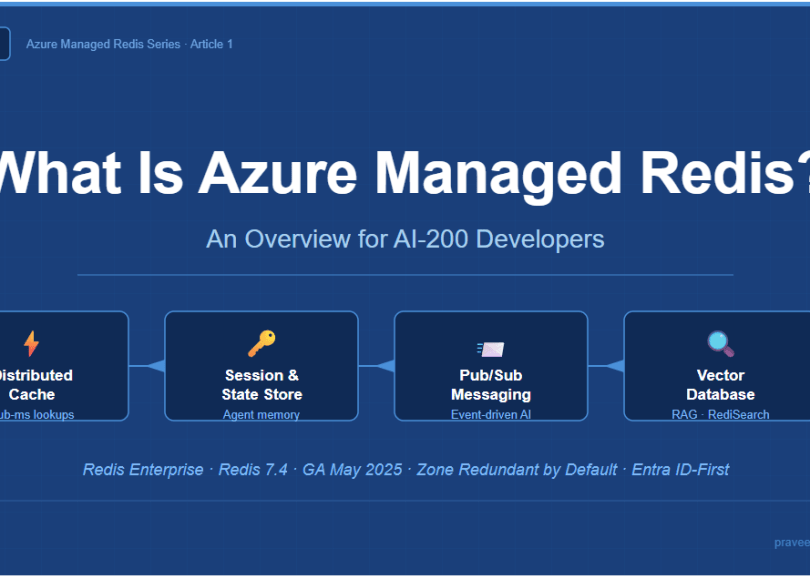
More Than a Cache: Four Roles AMR Plays in AI Applications
Below are few top features of AMR.
1. Distributed Cache
The most familiar use case. AMR stores the results of expensive operations — LLM inference outputs, embedding lookups, database query results — so subsequent requests can be served from memory in sub-millisecond time. At 10 Gbps network bandwidth on the higher tiers, AMR can handle the throughput of the most demanding caching workloads.
2. Session and State Store
AI applications are increasingly agentic — they maintain conversation history, intermediate reasoning steps, tool call results, and user preferences across multiple turns. AMR provides a fast, durable key-value store for all of this. With zone redundancy on by default, session data survives a datacenter failure without your app needing to handle it.
3. Pub/Sub Messaging Backbone
Redis has native pub/sub and Redis Streams support. In event-driven AI architectures, AMR can serve as the message bus between your ingestion pipeline, processing workers, and output handlers — without adding a separate service like Service Bus for lower-volume scenarios.
4. Vector Database
This is the capability that most directly connects AMR to AI-200. AMR ships with RediSearch, which adds vector similarity search on top of the Redis keyspace. You can store embeddings alongside their metadata, then run cosine or inner-product similarity queries with filtering — all in memory. For Retrieval-Augmented Generation (RAG) pipelines, AMR as a vector store gives you millisecond retrieval instead of the hundreds of milliseconds you’d pay with a disk-based vector DB.
For more features and scenarios of Azure Managed Redis, please go through the official link here https://learn.microsoft.com/en-us/azure/redis/overview#key-scenarios
| 🧠 Exam Tip If an AI-200 scenario asks you to select a service that handles caching, session state, AND vector search in a single managed service, Azure Managed Redis is the answer. No other Azure service covers all three in a single deployment. |
AMR Tiers: Picking the Right Shape
AMR offers four tiers. Each is optimized for a different workload profile. The exam will test your ability to match a scenario to the right tier.
| Tier | Best For | Key Capability | Max Memory |
| Balanced | General-purpose workloads | Even split compute / memory | 12 GB per shard |
| Compute Optimized | Session stores, high-throughput APIs | Higher vCPU ratio | 12 GB per shard |
| Memory Optimized | Large datasets, vector search | High memory per vCPU | 1.5 TB per cluster |
| Flash Optimized | Massive datasets on a budget | NVMe flash tier for cold data | 13 TB per cluster |
Security Defaults: What AMR Gets Right Out of the Box
AMR’s security posture reflects Azure’s shift toward Zero Trust by default. Three defaults are worth knowing for the exam:
- Entra ID-first authentication. AMR uses Microsoft Entra ID (formerly Azure AD) as the primary identity provider. You can assign Redis ACL rules to Entra users, groups, and managed identities — no passwords required. This aligns with least-privilege access patterns and eliminates credential rotation overhead.
- Zone redundancy on by default. On supported tiers (Balanced, Compute Optimized, Memory Optimized, Flash Optimized), AMR deploys replicas across availability zones automatically. You don’t opt in — you would have to opt out, and you should rarely want to.
- Private Link support. AMR integrates with Azure Private Link so traffic between your app and the Redis cluster never traverses the public internet. Combine this with a VNet-injected App Service or AKS cluster for fully private AI application networking.
Key Exam Takeaways
| Concept | What You Need to Know |
| Redis Enterprise vs. Open Source | AMR is built on Redis Enterprise (commercial). Azure Cache for Redis uses open-source Redis. |
| GA Date | Azure Managed Redis reached General Availability in May 2025. |
| Redis Version | AMR runs Redis 7.4. |
| Zone Redundancy | On by default on supported tiers — not opt-in. |
| Authentication Default | Entra ID-first; no password-based auth required. |
| Vector Search Module | RediSearch — enables cosine/inner-product similarity search over embeddings. |
| Flash Optimized Tier | Extends capacity to 13 TB using NVMe flash for cold data; DRAM for hot data. |
| Four AMR Roles in AI Apps | Distributed cache, session/state store, pub/sub messaging, vector database. |
| When to Choose AMR over ACR | Any scenario requiring vector search, >53 GB data, active-active replication, or Entra ID-native auth. |
Practical Scenario: AMR in a RAG Pipeline
Here’s how AMR would fit into a typical AI-200 Retrieval-Augmented Generation architecture:
- User submits a query to your Azure API Management endpoint.
- Your Azure Function generates an embedding of the query using Azure OpenAI.
- AMR (RediSearch): Performs a vector similarity search across your indexed document embeddings and returns the top-k most relevant chunks.
- The chunks are injected into the system prompt alongside the user’s original question.
- Azure OpenAI generates the final response.
- AMR (Cache): The embedding and the final response are cached. If the same or a semantically similar query arrives, the cache serves it directly — no OpenAI API call required.
- AMR (Session Store): Conversation history for the user’s session is persisted in AMR, enabling multi-turn dialogue without a database round-trip.
One service. Three active roles. Sub-millisecond latency at each step.
What’s Next
In the next article in this series, we’ll move from concept to configuration: standing up an AMR instance, connecting with Entra ID, and running your first vector similarity search against a document corpus.
Do you like this article? If you want to get more updates about these kind of articles, you can join my Learning Groups
Discover more from Praveen Kumar Sreeram's Blog
Subscribe to get the latest posts sent to your email.
